
Reviewed · WALKING TOURS
Palma’s Alternative History: A Self-Guided Audio Walk
Palma’s streets have a second script. This self-guided audio tour lets you learn the city’s “alternative history” at your own pace, with the narration starting at Parc de la Mar. I love the flexibility to start, pause, and continue whenever you want, and I also like that you get lifetime access to the tour in English or French. The main drawback is the phone app: one unhappy moment with VoiceMap can slow you down, especially if your battery is getting hammered.
You’ll be guided through big-name landmarks and smaller moments that add texture, from the Cathedral area to old neighborhoods and central squares. And because it works offline (audio, maps, and geodata are included), you’re not stuck hunting for reception. Still, you’ll want to bring your own smartphone and headphones, and you should be ready to follow directions on a screen as you walk.
If you’re visiting Palma with limited time and you like history told like a story instead of a lecture, this is a strong value. It’s also a private activity, so your group only competes with itself. Just read the fine print: it’s non-refundable and cannot be changed once booked.
In This Review
- Key highlights worth planning around
- Why an audio walk beats a checklist in Palma
- Price and logistics: $9.99, 1–1.5 hours, and what you must bring
- Your route through Palma’s center: Parc de la Mar to Plaça de Cort
- Parc de la Mar: the sea-built square that frames the big sights
- An Art Nouveau jewel from the early 1900s
- Can Marcel: a 17th-century house now used for a lounge stop
- Santa Eulalia Church: a 13th-century church with baroque interior
- A street shaped by Sa Riera torrent and old tournaments
- Plaça Major: the Mile Zero finish point for the center
- Plaça built in the mid-1800s: Saint Sebastian, January 19
- Cathedral of Palma (Seu): construction from 1230 to 1601
- Almudaina Palace: an Arabic royal palace from the 10th century
- La Llotja (former maritime stock exchange): built in 1428, free to enter
- What you actually learn: Palma’s alternative history, in human terms
- VoiceMap app reality check: good tech, but plan for quirks
- Best for: who this audio walk suits (and who should pick a different plan)
- Should you book Palma’s Alternative History audio walk?
- FAQ
- How much does Palma’s Alternative History cost?
- How long is the self-guided audio walk?
- Where do I start and where does it end?
- What language is the audio tour available in?
- Does the tour work offline?
- What do I need to bring?
- Are museum or attraction entrance fees included?
- Can I pause and resume the audio tour whenever I want?
- Is this a private activity?
- What are the opening hours?
Key highlights worth planning around
- Start at Parc de la Mar and hear how the sea-shaped square connects to the Cathedral and Almudaina Palace
- Pause and resume anytime, so coffee stops and photos don’t ruin your timing
- Offline audio, maps, and geodata so the walk stays smooth even with patchy mobile signal
- A fast path through major stops like the Seu (Cathedral), Santa Eulalia, and Plaça Major
- Free admission included for one major stop (La Llotja is open to the public without an entry fee)
- The show is only as good as your phone setup, so plan for VoiceMap quirks
Why an audio walk beats a checklist in Palma
Palma has a way of swallowing visitors into pretty streets, then quietly changing topics from one era to the next. A self-guided audio walk helps you catch those transitions without feeling rushed or herded. You’re walking a real route through the center, not just hopping between photo stops.
Two things make this style work well here. First, the narration is built for flow: you start near Parc de la Mar and then keep moving through the old core toward the end near Plaça de Cort. Second, you control the pace. If you want to stop for a look at the Cathedral facade or step into Santa Eulalia when it’s open, you can.
This is also priced for people who want value. At $9.99 per person for a one-hour to one-and-a-half-hour walk, you’re paying for guidance and context, not museum tickets. For many first-time visitors, that means you can spend your money on one or two places that actually require tickets later, while still getting the “why this matters” behind Palma’s main sights.
The walk is described as being led by Sandra, a long-time resident, with the story tracing Palma from ancient Talayotic culture through the Spanish Inquisition and into the elegance of old Palma. That makes the tour feel less like trivia and more like a guided stroll through layers.
Palma on foot, more routes

Price and logistics: $9.99, 1–1.5 hours, and what you must bring
Let’s keep it practical. The experience costs $9.99 per person and is available in English. Duration is listed as roughly 1 hour to 1 hour 30 minutes, depending on how often you pause for photos, read signs, or duck into churches.
You meet at Parque del Mar / Parc de la Mar in Palma and the route ends near Plaça de Cort, close to the town hall area. Opening hours are listed as 12:00 AM to 11:59 PM across the provided date range, which basically means you can slot this into almost any day.
Included items:
- Lifetime access to the tour in English or French
- VoiceMap app access for Android and iOS
- Offline access to audio, maps, and geodata
Not included:
- Your smartphone (and headphones)
- Any entrance tickets for museums or other stops
- Transportation, food, or drink
Near public transportation, so you can roll into the start point without complicated routing. And because it’s private for your group, you’re not playing the “stop-and-wait” game with strangers.
If you want the walk to feel easy, the biggest logistics upgrade is simple: charge your phone and bring headphones that actually work. This tour depends on VoiceMap, and one review noted that the app can be energy-hungry and glitchy on some devices.
Your route through Palma’s center: Parc de la Mar to Plaça de Cort
The walk is designed to connect landmarks that look impressive on their own but become more meaningful when you understand what came before them. You’ll start in a sea-linked square, then move through religious sites, civic spaces, and the architecture of commerce and power.
Below is the stop-by-stop experience as it’s presented, with why each place is worth your time and what might slow you down.
Parc de la Mar: the sea-built square that frames the big sights
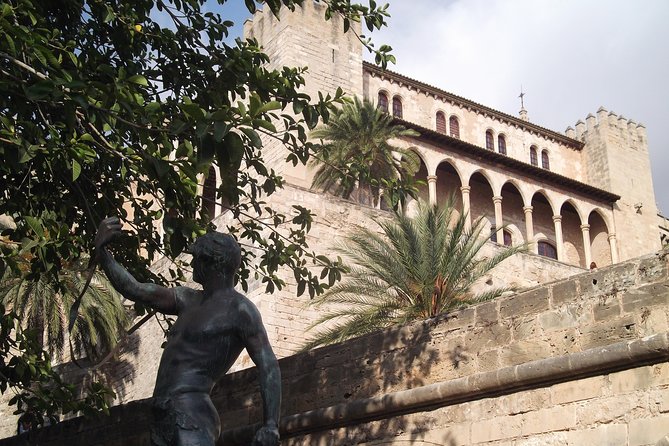
Your tour starts at Parc de la Mar, a charming square facing both the Cathedral and the Almudaina Palace. One detail that helps you “read” the place is that the square was built over the sea during the 1960s, at a time when Mallorca experienced a tourism boom.
This is a smart start point because it gives you a wide view and a clear sense of direction. It’s also a good place to set expectations: the tour is about seeing the same city from different angles, not just collecting monuments.
Tip: if you’re arriving early, this area is a good warm-up walk before you commit to the longer inner streets. If you’re already tired, start here anyway. The narration helps you settle into the route.
Easier days with a local guide
- Palma de Mallorca: Guided Tour of the Old Town★ 4.9 · 822 reviews
- Palma: Caves of Genova Ticket & Digital Audio Guide★ 3.9 · 820 reviews
- Palma de Mallorca Old Town Guided Bike Tour (Small Groups)★ 4.6 · 563 reviews
- Cala Varques: Guided Sea Caves Kayak & Snorkeling Expedition★ 4.8 · 534 reviews
- Cala Millor/Sa Coma: Guided Buggy Tour★ 4.7 · 348 reviews
An Art Nouveau jewel from the early 1900s
Next comes a splendorous monument built in the early 1900s, described as one of Palma’s Art Nouveau jewels. You don’t need a background in design to appreciate this stop. The point is contrast: Palma isn’t only Gothic stone and medieval churches. There are turns toward newer styles too, and your audio guide helps you notice them.
Potential drawback: because this stop is architecture-focused, it’s easy to rush past if you’re moving fast. If you care about details, slow down for a minute.
Can Marcel: a 17th-century house now used for a lounge stop
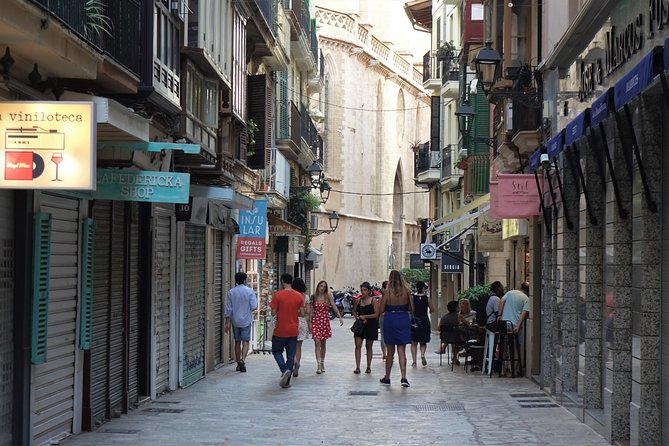
Then you reach a typical noble Majorcan house, built in the seventeenth century, formerly called Can Marcel. Today it hosts a lounge bar with a rustic, authentic design, and it’s suggested as a good place to stop during the tour.
This is one of the most “human” stops because it invites you to pause. Even if you don’t buy anything, it’s a moment where the city feels like daily life, not only sightseeing.
Practical note: the bar environment can be noisier than a church courtyard, so if you’re trying to listen carefully to narration, step in only after the audio point feels complete.
Santa Eulalia Church: a 13th-century church with baroque interior
Santa Eulalia is one of the oldest churches of Mallorca, built in the thirteenth century. The tour notes a key historical detail: the first kings of Mallorca were crowned there before the Cathedral was completed in 1601.
Inside, the decoration is described as baroque, and importantly: it’s free to visit. This is a rare “included value” stop inside a tour that otherwise does not include entrance fees.
If you’re the kind of traveler who likes religious buildings but hates wasting time hunting tickets, Santa Eulalia is a relief. You get a major interior style shift without paying extra.
A street shaped by Sa Riera torrent and old tournaments
The tour then takes you to a street where, in the past, the torrent of Sa Riera flowed through the city, dividing it in two. It also mentions knights’ tournaments organized along this route.
This is the kind of detail that makes an audio tour worth it. You can walk a normal street and still realize it used to be a natural boundary and a stage for spectacle. It turns the city into a living map.
Watch-out: if you’re expecting this to be dramatic ruins, it’s not. The magic is in the story you’re hearing, so keep your phone up and listen.
Plaça Major: the Mile Zero finish point for the center
The audio walk includes Plaça Major as a key square and calls it the Mile Zero of Palma. The narration finishes the audio portion roughly around the area of the town hall, but the experience explicitly highlights Plaça Major as a major historical stop.
Plaça Major is one of those places where you can feel why cities build rituals around squares. Even if you don’t stop for a long break, it’s a natural place to orient yourself for whatever you do next.
Plaça built in the mid-1800s: Saint Sebastian, January 19
Another central square comes next, built in the middle of the nineteenth century. It hosts the feast day of Saint Sebastian on January 19, described as the celebration of Palma’s patron saint.
If you’re there in season, this point may feel extra alive. If you’re not, it still works because it reminds you that Palma’s history isn’t frozen. It continues through public celebrations.
Cathedral of Palma (Seu): construction from 1230 to 1601
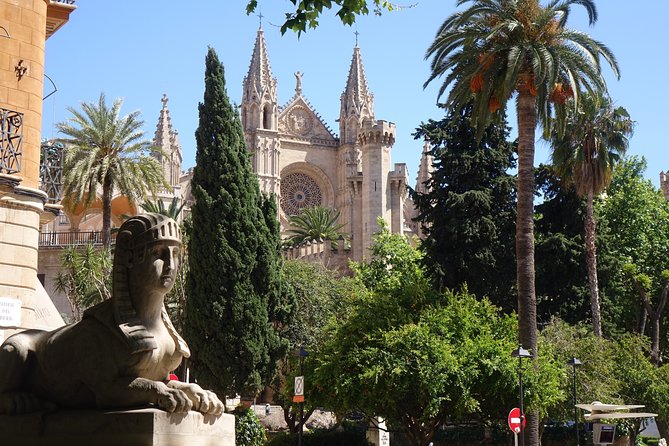
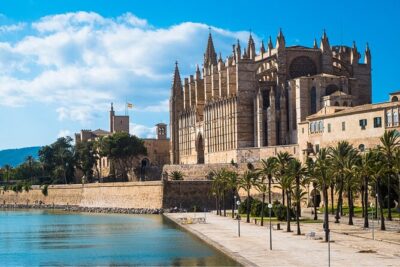
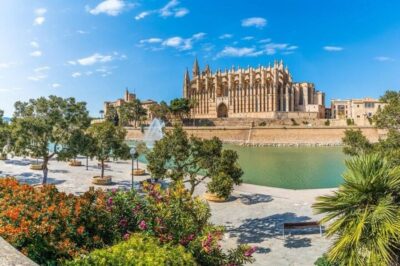
No Palma audio walk should skip the big centerpiece. The Seu, also called the Cathedral of Light, is described as the crown jewel of the city. Construction started in 1230 and was completed 371 years later, in 1601.
This tour doesn’t sell the Cathedral as a one-note monument. The point is to set it into Palma’s timeline. Seeing it from different angles while the narration explains what happened around it makes it feel less like a postcard and more like civic identity.
Note: the tour does not include entrance tickets, so if you want to go inside, check what’s needed locally.
Almudaina Palace: an Arabic royal palace from the 10th century
Next is the Almudaina Palace, an Arabic king palace built in the tenth century. It’s the oldest monument of Palma, and today it serves as the official King’s residence, where King Philip VI receives official visitors such as Presidents from other countries. The tour also notes it functions as a museum and a military building.
Even if you never step inside, this is a high-impact stop because it anchors the story in deep time. Palma’s later Gothic forms make more sense when you know an older royal layer exists beneath.
Again, entrance details are not included in the walk price, so treat this as a narrated exterior-focused moment unless you’ve confirmed what tickets might cost.
La Llotja (former maritime stock exchange): built in 1428, free to enter
The walk includes a beautiful Gothic building built in 1428, described as the former maritime stock exchange. It’s named as open to public, and the admission is free.
This is a great place to catch a different kind of Palma. Not church power this time, but trade and maritime administration. You’re learning what shaped the city’s wealth and movement.
If you’re short on time and wondering which stop is most worth stepping into, La Llotja is one of the best because it’s explicitly free.
What you actually learn: Palma’s alternative history, in human terms
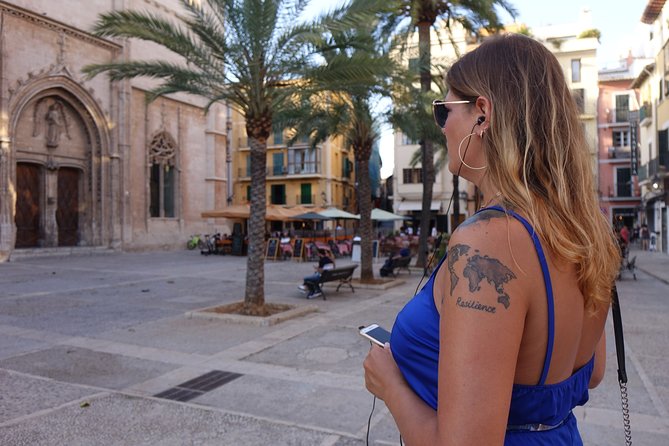
This is not just a list of facts about landmarks. The narration is built around the idea that Palma changes personality as centuries stack up.
The story line you’ll hear traces:
- ancient Talayotic culture
- the Spanish Inquisition
- old Palma’s elegance and later civic life
You also get those story beats tied to specific streets and buildings, like the Sa Riera torrent dividing the city and knights’ tournaments happening along it. That kind of “place-based history” is where audio tours earn their keep. You leave with a mental map that makes the city easier to revisit later.
I also like how the tour keeps pulling you away from one-dimension sightseeing. One moment you’re at the Cathedral’s long construction timeline. The next you’re in a seventeenth-century home now used as a lounge bar. That mix helps the city feel lived-in, not staged.
VoiceMap app reality check: good tech, but plan for quirks
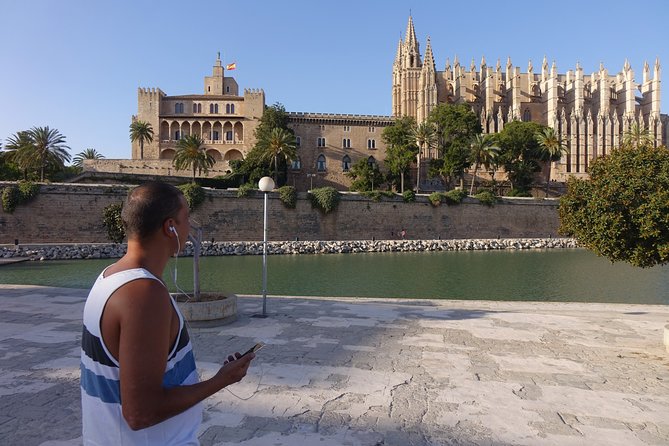
The tour runs through the VoiceMap app on Android and iOS, with offline audio, maps, and geodata included. In theory, that’s ideal: you can download once and walk without relying on cell service.
In practice, I want you to go in with eyes open. One detailed report criticized the app as unstable, describing repeated blocking and the need to close and reopen, then manually mark the point. That same account also complained about heavy battery drain. Another concern was energy use and the idea of an audio version without constant geolocation.
So here’s the practical takeaway:
- If your phone is picky with apps, do a quick test at home before your trip day.
- Bring a fully charged phone and consider a portable charger if you’ll use GPS on top of the audio app.
- If the app freezes at a crucial moment, expect you may need to restart and find your place again.
The trade-off is still worth it for many people, because the narration and offline support can make the route effortless. Just don’t assume every phone will behave perfectly, every time.
Best for: who this audio walk suits (and who should pick a different plan)
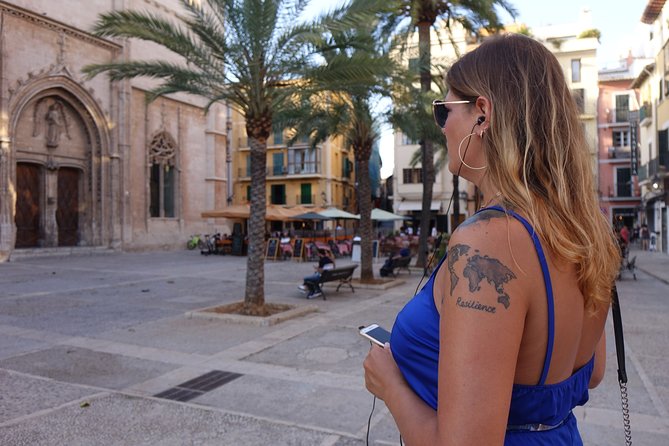
This tour fits best if you:
- want a first pass through Palma’s historic center
- like your history with stories, not just dates
- prefer pacing yourself instead of marching with a group
- have about 1 to 1.5 hours and want value at a low price
It’s also a good choice if you’re traveling with mixed interests. Churches and Gothic architecture are covered, but so are trade-era buildings, squares, and everyday-friendly stopping points like the Can Marcel bar setting.
Choose something else if:
- you hate phone-based navigation and would rather follow on-the-ground signage
- your device is prone to app crashes or severe battery drain
- you want a fully guided experience with zero tech dependence
Should you book Palma’s Alternative History audio walk?
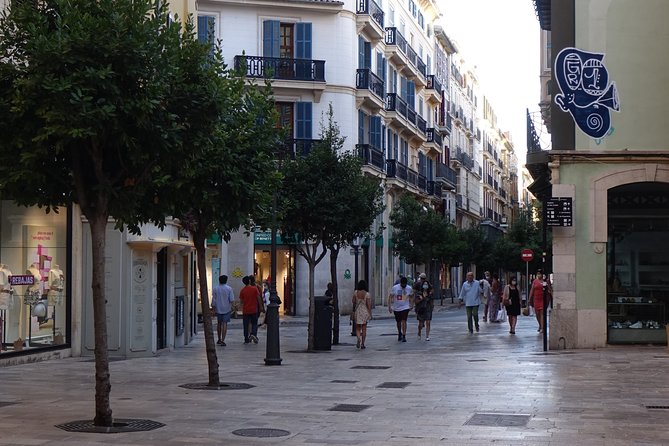
Here’s my honest call: I’d book it if you want an efficient way to understand Palma while walking at your own speed. For $9.99, lifetime access, and offline support, the value is strong, especially because you hit major sights like the Cathedral, Santa Eulalia, Almudaina Palace, and La Llotja without paying entrance fees upfront as part of the tour cost.
The only real reason to hesitate is the VoiceMap app performance risk. If you’ve had bad luck with map or audio apps before, plan extra charging time and bring headphones you trust.
One more decision tip: if you’re the kind of traveler who loves taking notes and lingering, you may stretch the walk beyond 90 minutes. If you’re trying to stack this with other plans, keep an eye on your pace and don’t wait too long at every square.
If you like history told through real places, this is a fun way to get your bearings fast and make Palma feel connected instead of random.
FAQ
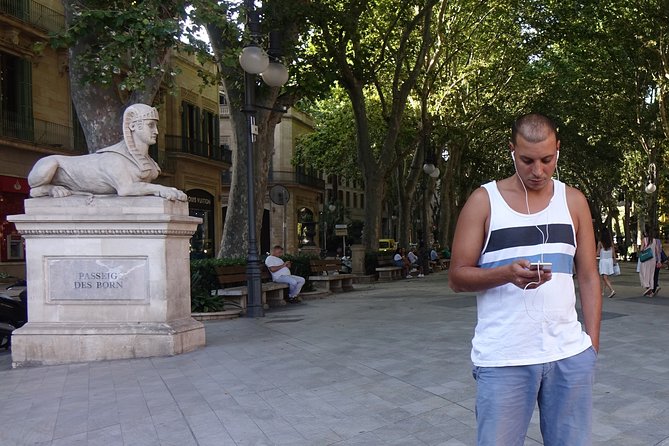
How much does Palma’s Alternative History cost?
The price is $9.99 per person.
How long is the self-guided audio walk?
It takes about 1 hour to 1 hour 30 minutes.
Where do I start and where does it end?
You start at Parque del Mar / Parc de la Mar, Palma, and the tour ends near Plaça de Cort in the center of Palma.
What language is the audio tour available in?
The tour is offered in English (and lifetime access is also available in French).
Does the tour work offline?
Yes. The experience includes offline access to the audio, maps, and geodata.
What do I need to bring?
You need a smartphone and headphones. The app is used through VoiceMap, and those devices are not included.
Are museum or attraction entrance fees included?
No. Tickets or entrance fees to museums or attractions en route are not included.
Can I pause and resume the audio tour whenever I want?
Yes. The audio tour is designed so you can begin and pause it at your choice.
Is this a private activity?
Yes. It’s described as a private tour/activity, meaning only your group participates.
What are the opening hours?
Opening hours are listed as 12:00 AM to 11:59 PM, with the provided date range running from 07/03/2020 to 02/16/2027.
Easier With a Mallorca Guide
- Palma de Mallorca: Guided Tour of the Old Town
★ 4.9 · 822 reviews - Palma: Caves of Genova Ticket & Digital Audio Guide
★ 3.9 · 820 reviews - Palma de Mallorca Old Town Guided Bike Tour (Small Groups)
★ 4.6 · 563 reviews - Cala Varques: Guided Sea Caves Kayak & Snorkeling Expedition
★ 4.8 · 534 reviews - Cala Millor/Sa Coma: Guided Buggy Tour
★ 4.7 · 348 reviews - Mallorca: Son Moix Stadium Guided Tour
★ 4.0 · 263 reviews
Palma on Foot, Continued
- Palma de Mallorca: City Walking Tour with The Cathedral
★ 4.0 · 657 reviews - Palma de Mallorca: Foodie Walking Tour of the Old Town
★ 4.6 · 372 reviews - Private walking tour in Palma de Mallorca with local guides.
★ 5.0 · 182 reviews - Palma, Cathedral & Valldemossa: Guided walking Tour
★ 4.1 · 182 reviews - Palma de Mallorca: Walking Tour, Cathedral & Local Tasting
★ 4.9 · 115 reviews - 2-Hour Private Walking Tour Through Palma’s Jewish Quarter
★ 5.0 · 66 reviews
More Mallorca Trips, Reviewed
- Palma: Cathedral of Mallorca Skip-the-Line Entry Ticket
★ 4.6 · 14,386 reviews - Palma de Mallorca: 5-Hour Catamaran Cruise with Lunch & Swim
★ 4.5 · 9,957 reviews - Porto Cristo: Caves of Hams Entry Ticket
★ 4.2 · 6,548 reviews - Palma de Mallorca: City Sightseeing Hop-On Hop-Off Bus Tour
★ 4.1 · 4,450 reviews - Mallorca: Island Tour with Boat, Tram & Train from the South
★ 4.4 · 3,888 reviews - Palma de Mallorca: Half-Day Catamaran Tour with Buffet Meal
★ 4.5 · 3,190 reviews
Just Reviewed: Fresh Mallorca Trips



Walking Tours, compared.
 ★ 4.0City Walking Tour with The CathedralFrom $34657 reviews
 ★ 4.6Foodie Walking Tour of the Old TownFrom $77372 reviews
 ★ 4.1Palma, Cathedral & Valldemossa: Guided walking TourFrom $40182 reviews
 ★ 5.0Private walking tour in Palma de Mallorca with local guides.From $266182 reviews
 ★ 4.9Walking Tour, Cathedral & Local TastingFrom $46115 reviews
 ★ 4.5Food Tasting Walking Tour in Palma with a LocalFrom $78105 reviews
 ★ 5.02-Hour Private Walking Tour Through Palma’s Jewish QuarterFrom $12066 reviews
 ★ 4.6Must see Walking Tour With A GuideFrom $3962 reviews
Browse the lists this tour appears in