
Reviewed · COASTEERING & CLIFF JUMPING
Coasteering South
One sentence can change your mood fast: cliff jumps next to the sea. Coasteering South is a 3-hour multi-adventure on the Balearic coast where the guide shifts the challenges to your level, from big-adrenaline moments to more controlled moves. What I like most is the mix: you’re not just walking the shoreline—you’re doing water sports that feel close to the action.
I also like how Juan (the guide in past bookings) stays attentive and focused on safety, so the thrills come with real structure. The second big plus is variety: aquatic zipline, rappel/rope work, cliff jumping, and deep-water soloing all hit different parts of your comfort zone.
One consideration: this isn’t for everyone. If you’re a non-swimmer, have heart problems, or you’re in the under-8 or over-70 age brackets, the operator lists clear limits for a reason.
In This Review
- Quick take before you commit
- Coasteering South: adrenaline with a coaching plan
- Price and what you’re really paying for ($82 per person)
- Where you start: the Cala Fornells parking meeting point
- Your 3-hour mix: aquatic zipline, jumps, and rope work
- Aquatic zipline over the sea
- Cliff jumping from different heights
- Rappel / abseiling (rope descend)
- Psychobloc-style sea action
- Deep water soloing: the sea is your only protection
- Safety and the guide: why Juan’s style matters
- What to bring (and what to skip)
- Who this is best for (and who should pass)
- Languages and communication on the coast
- A practical way to think about the “adrenaline” factor
- Should you book Coasteering South?
- FAQ
- Where is the meeting point?
- How long is the activity?
- How much does Coasteering South cost?
- What’s included in the price?
- What languages are available for the instructor?
- What should I bring?
- Is it suitable for children?
- Can non-swimmers join?
- What are the cancellation terms?
Quick take before you commit
- A real variety pack: aquatic zipline, cliff jumps, rappel/abseiling, psychobloc, and deep-water soloing in one session
- Level-adapted coaching: challenges can be adjusted for different abilities
- Safety-first energy: the guide’s attentiveness and patience are repeatedly highlighted
- Sea-only protection (for deep-water soloing): thrilling, but it demands calm nerves
- You’ll need water-ready gear: water shoes, swimwear, sunscreen, and snacks help you enjoy the full 3 hours
Coasteering South: adrenaline with a coaching plan
Coasteering South (run by Explora Mallorca) is based out of the Cala Fornells area and is built around one idea: the coast is a playground, if you have the right guidance. In 3 hours, you’ll move through several coastal “sea adventure” formats—some more vertical, some more flight-like, and some more pure body-and-water confidence.
The best part, for me, is that it’s not one-note. Aquatic zipline is a totally different sensation from dropping into the sea from a cliff, and rope descents ask for a different kind of focus. That variety matters if you want a day that feels like work (in the good sense) rather than a single stunt.
Scramble, leap and swim, more coasteering


Price and what you’re really paying for ($82 per person)
At $82 per person for a 3-hour activity, the value comes from two things that are often missing in “adventure-lite” tours.
First, you get the guide plus insurance and equipment. That matters because coasteering isn’t just about being outdoors—it’s about having proper gear and competent instruction when you’re near edges, water impacts, and exposure.
Second, the time is packed. Instead of one activity with a long wait, you’re scheduled for a multi-adventure format where you can experience multiple coastal elements in the same window. For people who are only in Mallorca for a short stretch, that’s a solid way to squeeze more fun out of a single half-day.
Where you start: the Cala Fornells parking meeting point
You meet at the public parking area of Cala Fornells beach. Showing up with your body ready to move is key, because once you’re kitted out and briefed, the day becomes physical fast.
Tip: plan to arrive a few minutes early so you can settle, use the bathroom if needed, and get your swim setup ready. Then you won’t be rushing while everyone else is preparing for the water.
Your 3-hour mix: aquatic zipline, jumps, and rope work
Think of the session as a set of coastal challenges. Some moments are about speed and flight. Others are about technique—using the guide and your own body control to stay smooth and safe.
Here are the main elements you can expect during the 3-hour run:
- Palma: Cathedral of Mallorca Skip-the-Line Entry Ticket★ 4.6 · 14,386 reviews
- Palma de Mallorca: 5-Hour Catamaran Cruise with Lunch & Swim★ 4.5 · 9,957 reviews
- Porto Cristo: Caves of Hams Entry Ticket★ 4.2 · 6,548 reviews
- Palma de Mallorca: City Sightseeing Hop-On Hop-Off Bus Tour★ 4.1 · 4,450 reviews
- Mallorca: Island Tour with Boat, Tram & Train from the South★ 4.4 · 3,888 reviews
Aquatic zipline over the sea
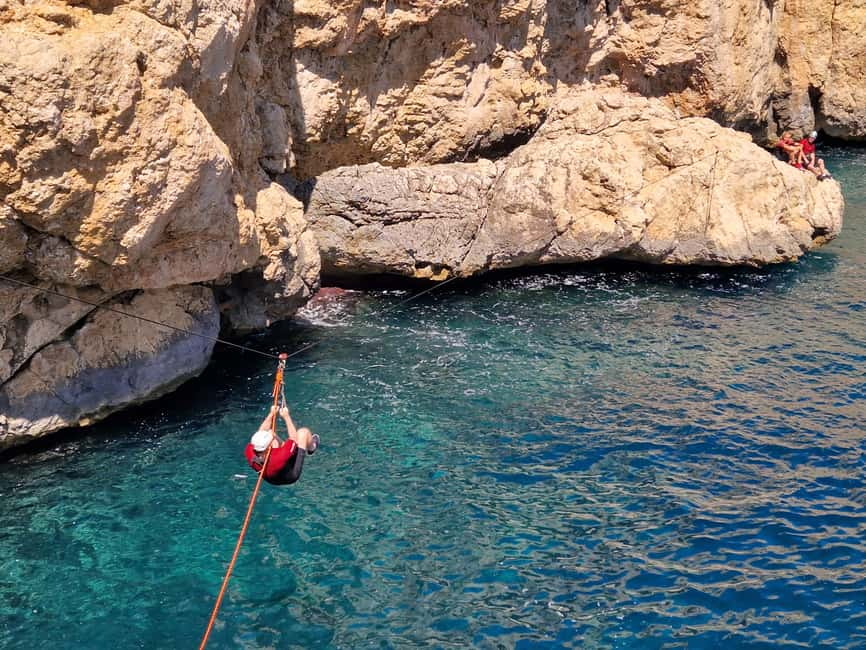
The aquatic zipline is described as a water zipline that lets you fly over the sea. It’s a great early win because it gives you that adrenaline without requiring you to immediately commit to a high jump or a complicated move.
For your comfort, the key advantage is simple: it’s structured. You’re moving along a line with a clear path, and the guide can usually help you find the right posture before you go.
Cliff jumping from different heights
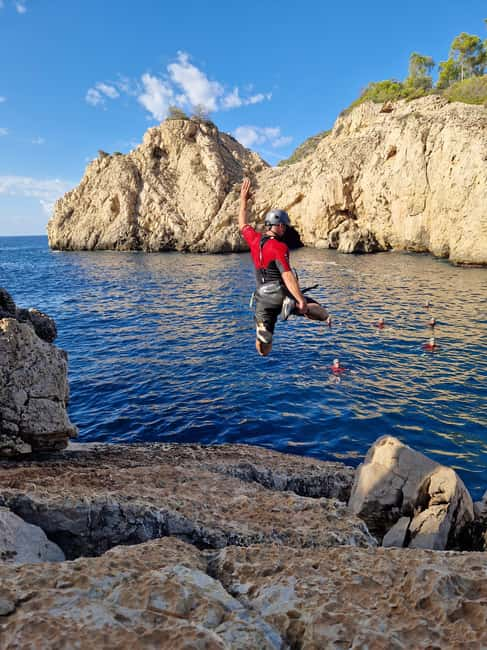
Cliff jumping is a core part of this experience, with jumps into the sea from different heights adapted to all levels. That adaptation matters more than you might think. If you’re nervous, a lower entry point can help you build trust quickly.
Drawback to keep in mind: even when heights are adapted, jumping into saltwater is still a shock to your body. If you’re the type who gets stressed by sudden impact, you’ll want to take your cues from the guide and commit only when you’re ready.
Rappel / abseiling (rope descend)
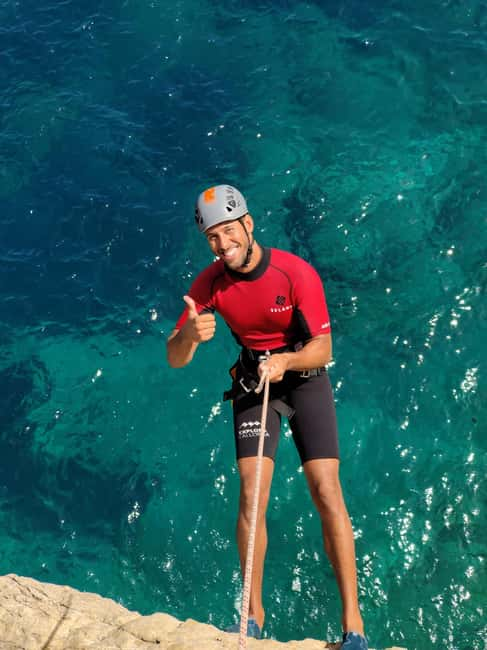
You’ll also do rappel and abseiling—rope descents where you control your movement down to the water. This shifts the session from pure thrill to technique.
If you like clear steps and a “do it right” feeling, rope work is usually where people calm down and focus. If you’re very anxious around ropes, tell your guide early so they can adjust support and pacing.
Psychobloc-style sea action
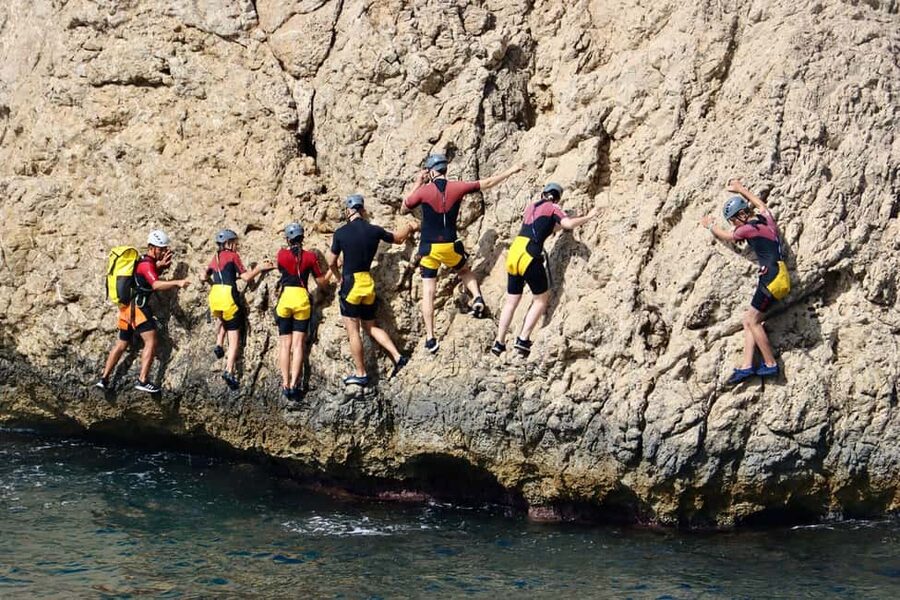
The activity list includes psychobloc. Even if you’ve never tried it, the “psychobloc” label signals that this is a climbing-adjacent moment with a water landing focus rather than traditional rope climbing.
Practical note: if you’re comfortable with heights but not with climbing moves, this can still be an exciting option because it’s tied to the sea and the guide’s adaptation for different abilities.
Deep water soloing: the sea is your only protection
Deep water soloing is described clearly: you’ll discover an adrenaline climbing experience, no rope, only the sea as protection, adapted for all levels.
This is the part that can separate “I’ll try it” from “I’m fully in.” You’ll be relying on timing, grip, and nerve, not a safety line. The value is huge if you like real confidence-building challenges: you learn what you’re capable of when the ocean is there and you’re not thinking about a rope.
A consideration: if you’re prone to panic or you’re uncomfortable with the idea of falling into open water, be honest with your guide. You can still enjoy plenty of the session, but deep water soloing is the element that demands the most mental buy-in.
Safety and the guide: why Juan’s style matters
The experience includes a guide, and the tone around safety matters. Past bookings highlight that the guide (Juan) was attentive and made sure the experience stayed safe. Another comment emphasized kindness and patience, which is exactly what you want when you’re doing high-adrenaline activities where your body might feel uncertain.
Here’s what that means for you on the day:
- You should expect instructions that help you move efficiently.
- You’ll want a guide who watches for discomfort and adjusts the challenge.
- You’ll benefit from someone who can patiently talk you through nerves, not just “send it.”
This kind of coaching is often the difference between a scary moment and a memorable one.
What to bring (and what to skip)
The operator is straightforward about what you should bring, and I agree with it. Pack like you’re going to be in the water and moving around:
- Swimwear
- Snacks (something you can eat before or between activities)
- Sunscreen
- Water shoes
Why water shoes matter: the coastline can be slick and rocky, and you’ll want something stable under your feet. Skip the flip-flops unless you enjoy doing the whole trip with sore soles later.
Who this is best for (and who should pass)
This activity is clearly labeled with limits. It’s not just “be brave.” It’s “be safe and physically compatible.”
It’s not suitable for:
- children under 8
- people with mobility impairments
- people with heart problems
- wheelchair users
- non-swimmers
- people over 70
If you are a competent swimmer and you like active days—short bursts of exertion, exposure to heights, and water-impact moments—this matches your style.
I’d especially recommend it for:
- people who want a single outing that mixes multiple coast activities
- travelers who get bored doing only one thing in one place
- anyone who enjoys structured adventure with a guide-led safety focus
Languages and communication on the coast
The instructor speaks English and Spanish. That’s useful because coasteering isn’t the time to rely on guesswork. You want to clearly understand how to move, where to place your feet, and what the next step feels like.
A practical way to think about the “adrenaline” factor
The headline says adventure and adrenaline, and it’s accurate. But adrenaline doesn’t automatically mean chaos. In a well-run coasteering session, adrenaline is a tool: it sharpens attention, increases excitement, and makes you feel alive.
If you want the best version of this experience, go in with the mindset of doing each element as a separate challenge:
- zipline = flight sensation
- cliff jumps = controlled commitment
- rope descents = technique and calm
- deep water soloing = nerve + body control without rope
Should you book Coasteering South?
Book it if you’re craving an active, 3-hour coast adventure and you want multiple adrenaline formats rather than a single stunt. The inclusion of guide, equipment, and insurance helps justify the $82 price, and the coaching style described by past guests suggests you’ll be supported through the scary parts.
Skip it if you don’t meet the safety limits (especially non-swimmer status or heart-related concerns) or if you know you freeze with heights or sudden water impacts. This isn’t about pushing through panic. The goal is fun with control.
If you’re on the fence, choose this when you’ll have good daylight and calm weather, and when you can come with swimwear, water shoes, sunscreen, and a bit of snack energy.
FAQ
Where is the meeting point?
You meet at the public parking area of Cala Fornells beach.
How long is the activity?
The duration is 3 hours.
How much does Coasteering South cost?
The price is $82 per person.
What’s included in the price?
It includes a guide, insurance, and equipment.
What languages are available for the instructor?
The instructor speaks English and Spanish.
What should I bring?
Bring swimwear, snacks, sunscreen, and water shoes.
Is it suitable for children?
No. It’s not suitable for children under 8 years.
Can non-swimmers join?
No. It’s not suitable for non-swimmers.
What are the cancellation terms?
There is free cancellation up to 24 hours in advance for a full refund.
More Mallorca Trips, Reviewed
- Palma: Cathedral of Mallorca Skip-the-Line Entry Ticket
★ 4.6 · 14,386 reviews - Palma de Mallorca: 5-Hour Catamaran Cruise with Lunch & Swim
★ 4.5 · 9,957 reviews - Porto Cristo: Caves of Hams Entry Ticket
★ 4.2 · 6,548 reviews - Palma de Mallorca: City Sightseeing Hop-On Hop-Off Bus Tour
★ 4.1 · 4,450 reviews - Mallorca: Island Tour with Boat, Tram & Train from the South
★ 4.4 · 3,888 reviews - Palma de Mallorca: Half-Day Catamaran Tour with Buffet Meal
★ 4.5 · 3,190 reviews
Cliffs, Leaps and Swims
- Mallorca: Kayaking, Sea Cave, Cliff Jumping & Snorkel Tour
★ 4.8 · 1,447 reviews - Mallorca: Kayaking, Sea Cave, Cliff Jumping & Snorkel Tour
★ 5.0 · 769 reviews - Mallorca: Half-Day Coasteering Experience
★ 4.7 · 447 reviews - Estany d’en Mas: Coastal Hike, Abseil & Sea Cave Exploration
★ 4.9 · 162 reviews - Kayak Tour with Caves, Snorkeling and Picnic (+ Cliff Jump)
★ 5.0 · 118 reviews - Small-Group Cliff Jumping Experience in Mallorca
★ 5.0 · 84 reviews
Just Reviewed: Fresh Mallorca Trips
Coasteering & Cliff Jumping, compared.
 ★ 4.8Kayaking, Sea Cave, Cliff Jumping & Snorkel TourFrom $801,447 reviews
★ 5.0Kayaking, Sea Cave, Cliff Jumping & Snorkel TourFrom $83769 reviews
 ★ 4.7Half-Day Coasteering ExperienceFrom $88447 reviews
 ★ 4.9Estany d’en Mas: Coastal Hike, Abseil & Sea Cave ExplorationFrom $88162 reviews
 ★ 5.0Kayak Tour with Caves, Snorkeling and Picnic (+ Cliff Jump)From $83118 reviews
 ★ 5.0Small-Group Cliff Jumping Experience in MallorcaFrom $9084 reviews
 ★ 4.94-Hour Cliff Jumping AdventureFrom $8856 reviews
 ★ 5.0Coasteering in South Mallorca with TransfersFrom $9055 reviews
Browse the lists this tour appears in